William Beaumont—Wendy Beaumont
The Dark HalfWilliam Beaumont and Wendy Beaumont are twin siblings whose bond crosses the boundary between shared feeling and shared bodily experience. Their first striking connection appears in an ordinary afternoon of infant play: after Wendy falls and bruises her thigh, William—who has suffered no comparable injury—develops a bruise matching hers in location, shape, and color. The parallel turns their closeness into evidence, helping Thad Beaumont recognize that the twins’ link is deeper than their tendency to cry together and placing their relationship beside the novel’s other, more dangerous forms of doubling.
Identity and Early Signs of Their Bond
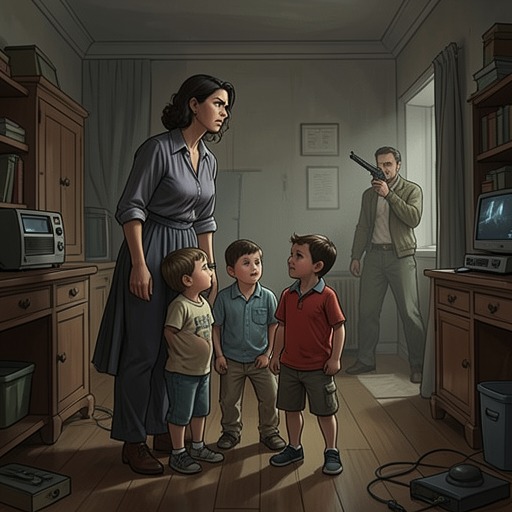
At eight months, William and Wendy are in the unsettled interval between crawling and walking. They pull themselves upright against whatever is nearby, from a chair leg or coffee table to an unstable cardboard carton, and turn the living room into what Thad sees as an age of inexhaustible mess-making. The twins’ connection first takes a familiar form: when one cries, the other joins in. Yet their parallel reactions also establish how readily distress passes between them.
During an afternoon play session, William hauls himself up at the coffee table, reaches for Liz Beaumont’s teacup, and spills its cold dregs over himself. He falls backward onto his bottom, strikes his mouth with the cup, and begins to wail; Wendy promptly joins him. Liz takes William upstairs to soothe and clean him, leaving Thad to watch Wendy. The scene begins in slapstick domestic disorder, but its paired crying prepares the reader to notice that the twins’ connection may involve more than sympathy.
The Fall and the Matching Bruise
Wendy later falls down the stairs. Liz finds her and tends to her, and the immediate danger passes: Wendy’s sobs subside, she remains responsive, and the injury appears to be a bump rather than a grave wound. Liz admits that the strain of caring for the twins has left her feeling as if she is continually on the verge of her period, a candid detail that keeps the episode rooted in bodily fatigue and family life rather than presenting the children as abstract supernatural signs.
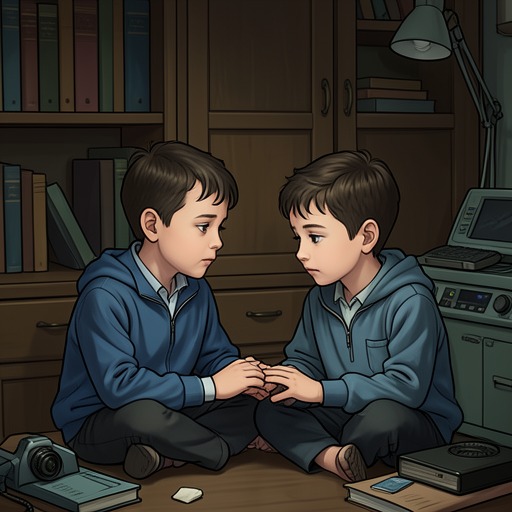
As Wendy calms, William reaches for his sister’s shirt and babbles to her. Their parents hear the exchange as if the infants are conversing in a private language, a sound that is familiar in its tenderness but uncanny in its apparent mutual understanding. Wendy touches William’s shoulder; both continue cooing. The narration playfully renders their exchange as an affectionate conversation, ending with Wendy’s comic worry about having soiled her diaper. Their intimacy is made vivid through a scene that is at once ordinary infant behavior and an invitation to imagine a private twin world.
The consequences of Wendy’s fall become more startling later that evening. By the time the twins wake from their naps, the bruise on her upper thigh has darkened to purple and taken on a distinctive mushroom shape. When Thad looks at William, he finds a mark on the upper thigh of his right leg that is almost identical in shape, color, and location. William had fallen onto his bottom while handling the teacup, but, as far as Thad knows, he had not injured his leg. The matching mark therefore has no ordinary cause in the scene to explain it.
Thad names the connection plainly: the twins share their bruises, too. His calm response is significant. Seeing the marks produces what he experiences as a sudden light behind his eyes and a partial understanding of the birds and of what he should do next. The bruise does not resolve the supernatural mystery, but it gives him a concrete instance of one body registering what happened to the other.
Thad’s Interpretation and the Larger Double
Thad records the discovery in his journal, noting the twins’ familiar pattern of crying together before setting it beside the stronger link revealed by the bruises. His self-interview style helps him work toward what he thinks: the marks are so alike that photographs laid over one another might form a single image. In that act of examining the twins’ bond, he recognizes another duality in his own habits of thought, or perhaps another aspect of a division already fundamental to his mind and spirit.
The journal entry also distinguishes what the twins may know from what Thad knows. William must feel that his leg hurts, but he cannot know that Wendy’s fall caused his bruise; he experiences only the hurt place. Thad then applies the possibility of such an uncomprehended vulnerability to George Stark. Stark knows there is something between them, Thad reasons, but may not understand the full nature of it. Thad’s inference links the twins’ involuntary bodily correspondence to his own connection with Stark without claiming that the two relationships are identical.
The Sparrows and the Novel’s Supernatural Pattern
The bond between William and Wendy belongs to a wider pattern in which connections exceed ordinary explanation and in which other beings act with a force of their own. At Gold’s Junkyard and Auto Supply, Thad and Rawlie DeLesseps discover that sparrows have silently covered the stacked wrecks across the back ten acres. Rawlie calls them psychopomps and asks what their appearance means. Later, around the Williamses’ driveway, a sparrow lands on Alan Pangborn’s shoulder, hops onto his hand, and then returns to the flock; birds fill the trees across the lake, and the accumulated weight breaks a branch. Alan retreats from the driveway, while the flock remains concentrated around the house as if it were holding back or staging itself.
On the road to the lake house, Thad finds the sparrows in such numbers that they are not merely beside the road but seem to constitute it. A bird settles on the hood of his car and peers in with an unsettling, dispassionate curiosity. Thad realizes that reaching the house will require driving over them. At the climax, the flock’s purpose becomes legible: the psychopomps have come to escort George Stark back to the land of the dead. They cover Stark as he struggles against them, transforming the novel’s recurring sparrow presence into an active supernatural force rather than a decorative omen.
The twins’ matching bruises do not themselves explain the sparrows or establish a direct cause-and-effect link between the children and Stark’s fate. Their importance is relational and structural: the marks make bodily transmission unmistakable, while the sparrows extend the novel’s inquiry into bonds that exceed individual control. William and Wendy’s connection appears first in cries, touch, and private-seeming babble, then in a bruise each bears; beside the contest between Thad and Stark, that quiet correspondence offers an intimate, domestic form of doubling.